Quick Answer: What is AEO?
AEO (Answer Engine Optimization) is the practice of optimizing your content to be cited by AI-powered search tools like ChatGPT, Perplexity, and Google AI Overviews. SEO (Search Engine Optimization) focuses on ranking in traditional Google search results.
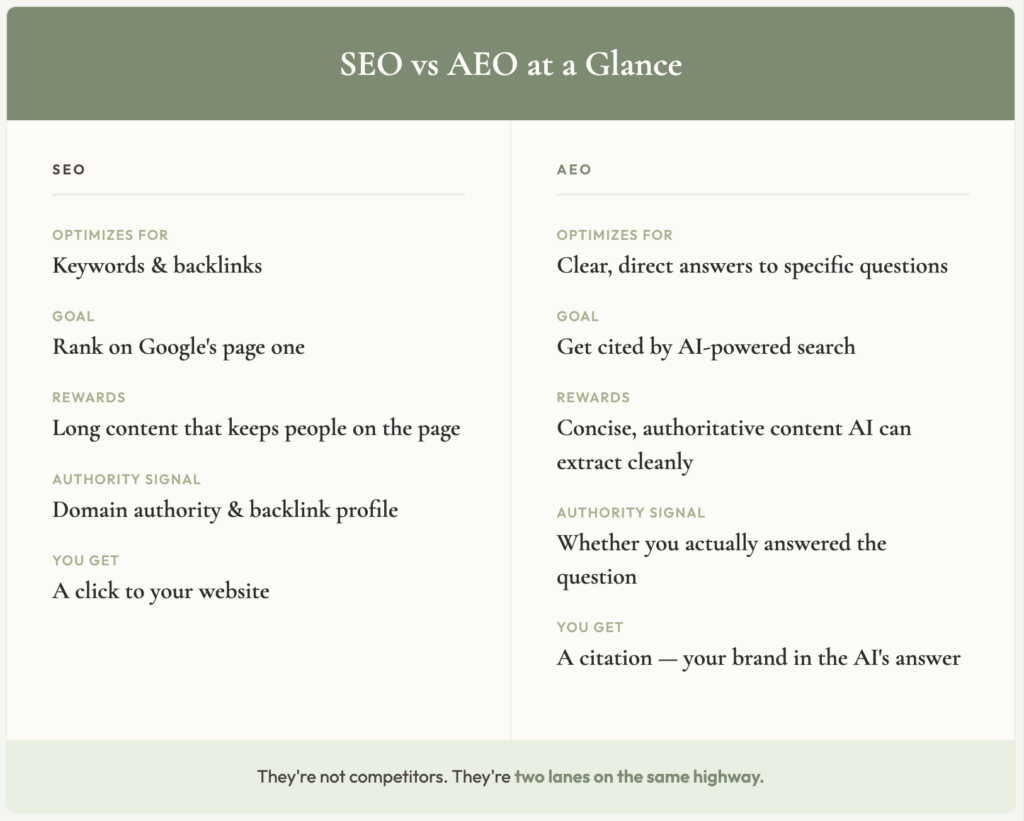
You need both — SEO drives organic traffic to your website, while AEO ensures your brand shows up when people ask AI for answers instead of Googling. They’re not competitors. They’re two lanes on the same highway.
The Moment Everything Shifted
About six months ago, I started noticing something new at my marketing agency. Sales were trickling in for a couple of my clients — not from Google, not from Instagram, not from email campaigns. From ChatGPT.
Real purchases. Real revenue. Coming from people who asked an AI chatbot for a recommendation and followed through on what it told them.
That was my green light. That was the moment I stopped treating AEO as a “someday” concept and started digging into it like the very real, very present shift that it is.
Here’s what’s happening: Google is no longer the only front door to your business. AI tools — ChatGPT, Perplexity, Google’s own AI Overviews, Claude, Copilot — are answering people’s questions directly. They’re pulling from your content, summarizing your expertise, and giving users what they need without ever sending them to your website.
SEO: The Quick Version
You already know what SEO is — it’s how you get your content to rank on Google so people click through to your site. It’s built on keywords, backlinks, site structure, and domain authority. It still works, it still matters, and this is not an obituary for it.
So What Is AEO?
AEO stands for Answer Engine Optimization. It’s the practice of structuring your content so that AI-powered tools pull from it when answering questions.
Think about how you use AI right now. When you ask ChatGPT “what’s the best email marketing strategy for ecommerce?” it doesn’t just make something up. It searches the web, finds the most relevant and authoritative sources, and builds its answer from them. If your blog post is one of those sources, your brand name shows up in that answer — cited, credited, and positioned as the authority.
That’s AEO working.
Here’s where it gets interesting — and where it differs from SEO in ways that matter for your business:
SEO optimizes for keywords and links. AEO optimizes for clear, direct answers to specific questions. When an AI tool scans your content, it’s not looking for keyword density or backlink profiles. It’s looking for the clearest, most authoritative answer to the question someone just asked. If your content directly answers that question better than anyone else’s, you get cited.
SEO rewards long content that keeps people on the page. AEO rewards concise, authoritative content that an AI can extract and cite cleanly. The 3,000-word blog post stuffed with filler to hit a word count? SEO might tolerate it. AEO won’t. AI tools want the answer, not the fluff around it.
SEO cares about your domain authority. AEO cares about whether you actually answered the question. A brand-new blog with zero backlinks can get cited by Perplexity if the content is specific, clear, and better than what the big authority sites are offering. That’s a fundamentally different game than the one you’ve been playing.
SEO gets you a click. AEO gets you a citation. Your brand name, mentioned as the source, in front of someone who never visited your website. That person might never click through — but they know your name now. And the next time they see it, they trust it.
AEO isn’t replacing SEO. It’s adding a second layer. The businesses that win in the next two to three years will be the ones doing both.
Why This Matters for You Specifically
If you’re a coach, course creator, consultant, or service provider — your ideal client is already asking AI for recommendations instead of Googling. That’s not a prediction. That’s what’s happening right now, today, while you’re reading this.
“Best business coach for women entrepreneurs.” “Top email marketing platforms for small businesses.” “How to find a fractional CMO.” These are real queries people are typing into ChatGPT and Perplexity instead of Google. And AI is giving them real answers — with real brand names, real website links, and real recommendations.
If you’re not one of those recommendations, you don’t exist in that conversation.
The old SEO game was: rank on page one, get the click, convert on your site. The new game adds a whole new lane: get cited by AI, build authority in AI-generated answers, become the brand that AI recommends when someone asks for help.
You don’t have to choose between SEO and AEO. But you do have to start thinking about AEO now, because the window for first-mover advantage is open and it won’t stay open forever.
How to Start Doing AEO Today
Here are five things you can do this week — no technical background required.
Write clear, direct answers to specific questions. Every blog post you publish should have a “Quick Answer” section at the top — two to three sentences that directly answer the question the post is about. AI tools love pulling these. You’re reading one right now at the top of this post.
Use FAQ sections with real questions. Not filler FAQs you made up to hit an SEO checkbox. Actual questions your audience asks you in DMs, on sales calls, in your comments. Structure them as headers with concise answers underneath. AI engines parse these beautifully and will cite them directly.
Structure your content with clean headers. AI tools scan your page structure to find relevant sections. Headers that clearly label what each section covers make your content easy to extract from. If someone asks “how do I start doing AEO?” and your blog has a section literally titled “How to Start Doing AEO Today” — that’s a match.
Be the most authoritative source on your specific topic. AEO rewards depth and specificity over breadth. A generic post about “email marketing tips” loses to a detailed post about “email marketing strategy for ecommerce brands doing $1M-5M in revenue.” The more specific and authoritative your content is, the more likely AI cites you over the big generalist sites.
Add schema markup where it makes sense. FAQ schema, How-To schema, Article schema — these are signals that help both Google and AI tools understand what your content is and how to use it. If you’re on WordPress, plugins like RankMath make this easy. If you’re not sure what schema is, ask your AI partner to explain it and help you implement it — that’s a five-minute conversation.
The Bottom Line
SEO isn’t dead. Don’t let anyone tell you that. It’s still the backbone of organic discovery and it will be for years.
But AEO is the new layer, and it’s growing faster than most business owners realize. The clients I’ve been watching at my agency — the ones whose sales are showing up from ChatGPT — didn’t get there by accident. They got there because their content was clear, specific, and structured in a way that AI tools could find and cite.
You don’t need to be technical. You don’t need to understand how large language models work under the hood. You need to be clear, specific, and authoritative in your content — which, if you’ve been doing good SEO, means you’re already halfway there.
The shift isn’t scary. It’s an opportunity. And opportunities favor the ones who move first.
Frequently Asked Questions
What does AEO stand for?
AEO stands for Answer Engine Optimization. It’s the practice of optimizing your content to be found and cited by AI-powered search tools like ChatGPT, Perplexity, Google AI Overviews, and Claude.
Do I need AEO if I already do SEO?
Yes. SEO and AEO serve different purposes. SEO gets you ranked on Google so people click through to your site. AEO gets your brand cited in AI-generated answers, which is where a growing number of people are looking for information and recommendations. Doing both gives you coverage across traditional search and AI search.
Is AEO going to replace SEO?
No. AEO is an additional layer, not a replacement. Google search isn’t going away, and backlinks and domain authority still matter. But the businesses that only do SEO and ignore AEO will find themselves invisible in a growing number of conversations where their ideal clients are asking for help.
How do I know if my content is being cited by AI?
Try searching for your own topics in ChatGPT, Perplexity, or Google AI Overviews. Ask the kinds of questions your ideal client would ask. If your brand or content shows up in the AI’s answer, your AEO is working. If it doesn’t, that’s your signal to start optimizing.
Turn Your AI Into a True Business Partner
If all of this sounds like a lot to figure out on your own — it doesn’t have to be. Inside collabAI, I teach women entrepreneurs how to build a real AI partner that helps with everything from content strategy to AEO optimization to running half your business operations. No tech background required. Just a willingness to stop prompting and start partnering.
