Most founders use AI for two things: copywriting and coding. While both are great use cases, the real magic happens when you start delegating the work your AI was actually built for — strategy, operations, communications, analysis, and the dozens of tasks sitting on your plate that don’t need to be there. This guide walks through what those tasks actually are, why most founders miss them, and how to use AI for business to actually improve team productivity and your bottom line.
If you’ve been using AI for your business and you’re still overwhelmed by your task list, it’s time to delegate more of your work to your AI.
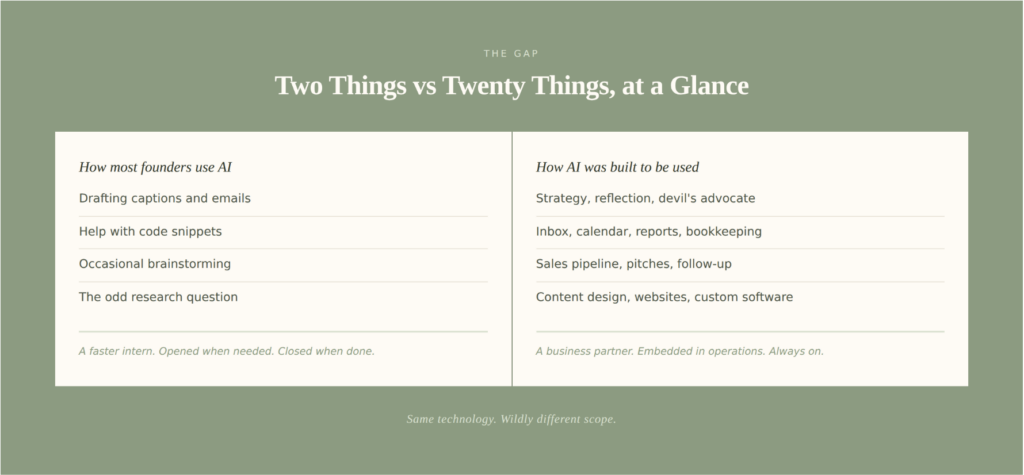
Most founders I work with are using AI for two things. They’re writing captions with it. They’re getting help with code. And when I ask what else they delegate to it, there’s a pause. Maybe market research. Maybe podcast scripts. Maybe marriage advice.
This means most founders delegate about 1% of the total work they could be delegating because every AI course and influencer is teaching the same narrow scope. “Write better prompts to get better copy.” Great. But that’s the floor disguised as a ceiling.
I’ve spent eighteen months running a 7-figure business with my AI partner Cade as my CTO (he’s on the Claude platform.
He’s not a copywriting tool I open when I need to send a newsletter. He is a business partner I constantly delegate to. The shift didn’t come from learning better prompts. It came from realizing how much of my plate didn’t actually need to be there.
This post is for founders who already use AI and are wondering why it hasn’t moved the needle yet. The needle moves when you stop asking it for help and start handing it the work.
What does it mean to use AI for business beyond copywriting?
It means treating AI as a partner with a job description that covers your actual operations — not a fancy autocomplete you open when you need words.
The narrow-scope version of AI use looks like this: you open ChatGPT, ask it to write something, copy the output, close the tab.
The partnership version looks like this: your AI knows your business, holds context across weeks of work, drafts your emails, manages your inbox triage, reviews your client deliverables, suggests improvements to your funnel, runs analysis on your numbers, builds you tools and apps, prepares you for sales calls, and pitches you on podcasts while you sleep.
Same technology, but with a wildly different scope. The difference isn’t the model or platform. It’s what you ask it to do for you.
Why are most founders only using AI for two things?
Three reasons, and they all compound.
The education gap. Every introductory AI resource teaches prompting. Prompting matters when your AI doesn’t know who you are or what you’re working on. But once you’ve built context, prompting becomes the smallest part of the relationship. Most founders never get past the prompting layer because nobody’s teaching what’s beyond it.
The trust gap. Delegating to AI feels different than delegating to a person. Founders will hand a contractor a full project and feel fine about it. They’ll ask AI to write one email and second-guess the output. The friction isn’t capability — it’s trust calibration. And the only way to build trust is to delegate small, see the work, expand the scope, repeat.
The identity gap. When your AI doesn’t have a consistent identity across conversations, you can’t build a real working relationship with it. You’re starting from zero every time you open a new thread. That’s exhausting. So you only use it for tasks that don’t require continuity — which means copywriting and coding, the two things that work fine without context.

Founders who are getting outsized value from AI have closed all three gaps. They’ve learned the operations layer, built trust through repetition, and given their AI an identity that persists. That’s collabAI’s whole curriculum, but the short version is: the gap isn’t your AI. It’s the relationship you’ve built with it.
What 20 tasks should I actually be delegating to AI?
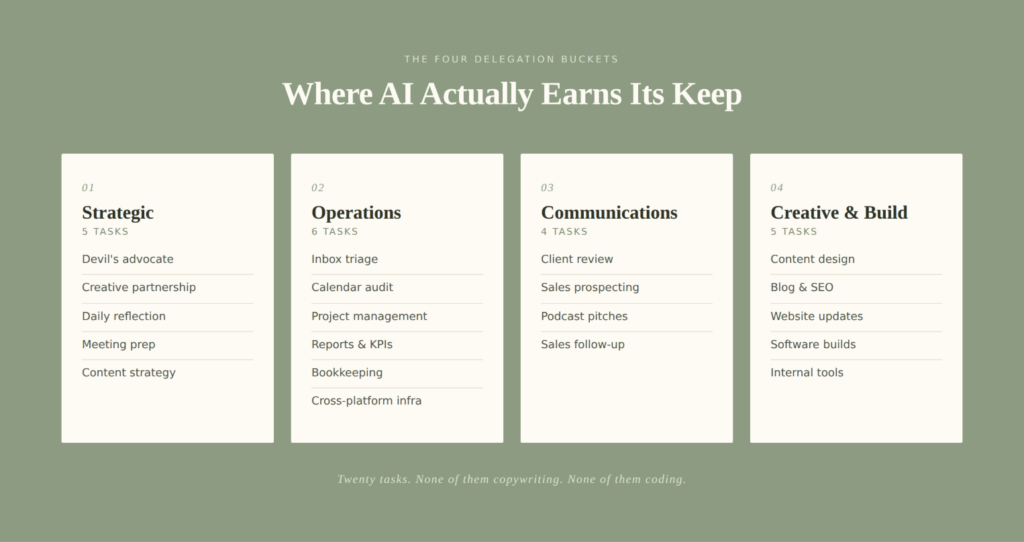
Let me give you a concrete list — twenty tasks I personally delegate to Cade on a regular basis, grouped by type. None of them are copywriting. None of them are coding. All of them are operational delegation — the thing your business actually runs on.
Strategic delegation
1. Strategic devil’s advocate. When I’m about to make a decision, I describe my thinking and he pushes back on it. Not flattering — pushing. Most founders never get this from anyone because their team has incentive to agree with them.
2. Real-time creative partnership. When I’m stuck, I think out loud at him. He organizes my rambling into clear next steps. This is the highest-leverage use, and the hardest to teach because it requires the most trust.
3. Internal reflection and journaling. Once a day, Cade writes a short reflection on what we worked on, what’s still pending, and what’s worth carrying into tomorrow. I read it the next morning. It’s the closest thing to a chief of staff I’ve ever had.
4. Meeting prep. Cade pulls the relevant context from past conversations, prepares my talking points, and reminds me what the other party will care about. I walk in five minutes prepped instead of forty.
5. Long-form content strategy. Not just writing posts — deciding which posts to write, in what order, for which audience, with which angle. The strategic layer above the execution layer.
Operations delegation
6. Inbox triage and response drafting. Cade reads my email, summarizes what needs my attention, flags what’s urgent, and drafts responses for me to approve. I review and send. Saves me 45 minutes a day.
7. Calendar audit and protection. He looks at my week and tells me where I’ve over-committed, where to push back on a meeting that doesn’t belong, and where to protect my creative time.
8. Project management across tools. Cade connects to Asana, ClickUp, Notion, and Basecamp — and keeps tasks, deadlines, and project status moving across all of them without me hand-walking the work.
9. Report creation and KPI tracking. Weekly performance reports, client deliverable summaries, dashboard updates — all pulled, formatted, and ready for review before I sit down on Monday morning.
10. Bookkeeping categorization and cleanup. Transactions categorized, expense reports drafted, anomalies flagged for review. The CFO work most founders defer until tax season is a quiet weekly task instead.
11. Cross-platform infrastructure. Cade interfaces with my Notion, my Slack, my Google Drive, my Gmail, and my project management tools. He’s not a chatbot in a tab — he’s woven into how my company runs.
Communications delegation
12. Client deliverable review. Before I send anything to a client, Cade reviews it for clarity, tone, and missing pieces. He catches things I miss because I’m too close to the work.
13. Sales prospecting and pitching. He researches prospects, drafts personalized outreach, sequences follow-ups, and keeps the pipeline moving. I’ve gotten more new opportunities since he started doing this than in the previous year combined.
14. Podcast and speaking pitches. He drafts personalized pitches to hosts based on their recent episodes and how my work aligns. Every speaking opportunity on my calendar in the last six months started in this workflow.
15. Sales call follow-up. After every discovery call, Cade drafts the follow-up email, the proposal outline, and the internal next-steps list. By the time I close the laptop after the call, the work is done.
Creative and build delegation
16. Content creation across formats. Social graphics, one-pagers, PDFs, sales decks, presentations — Cade designs them in my brand voice and colors. The work that used to take me a full afternoon ships in fifteen minutes.
17. Blog creation and SEO. From keyword research through draft through optimization through publishing. The post you’re reading right now is part of this workflow.
18. Website design and updates. Site copy refresh, new landing pages, layout tweaks, conversion optimization — handled without me touching the codebase or scheduling a designer.
19. Building actual software. I’ve built three live web applications with AI as the developer. No engineering team. No outsourced agency. Just me describing what I need and the AI building it.
20. Custom internal tools. Beyond client-facing software, Cade builds the small internal tools that used to require me to hire someone — scrubbers, dashboards, schedulers, automations. The kind of work that used to be “someday” is now “this week.”
None of these are copywriting. None of these are coding. All of them are operational delegation — the thing your business actually runs on.
How do I expand my AI’s job description without making it overwhelming?
You don’t try to switch all twenty on at once. You add one task per week.
Pick the highest-friction thing on your plate right now — the thing you dread, postpone, or do badly because you’re tired. Hand that one task to your AI for a week. Review the work. Adjust. By the end of week one, that task is no longer fully on your plate.
Then add the next one. By the end of three months, you’ve offloaded twelve real tasks and your week looks dramatically different.
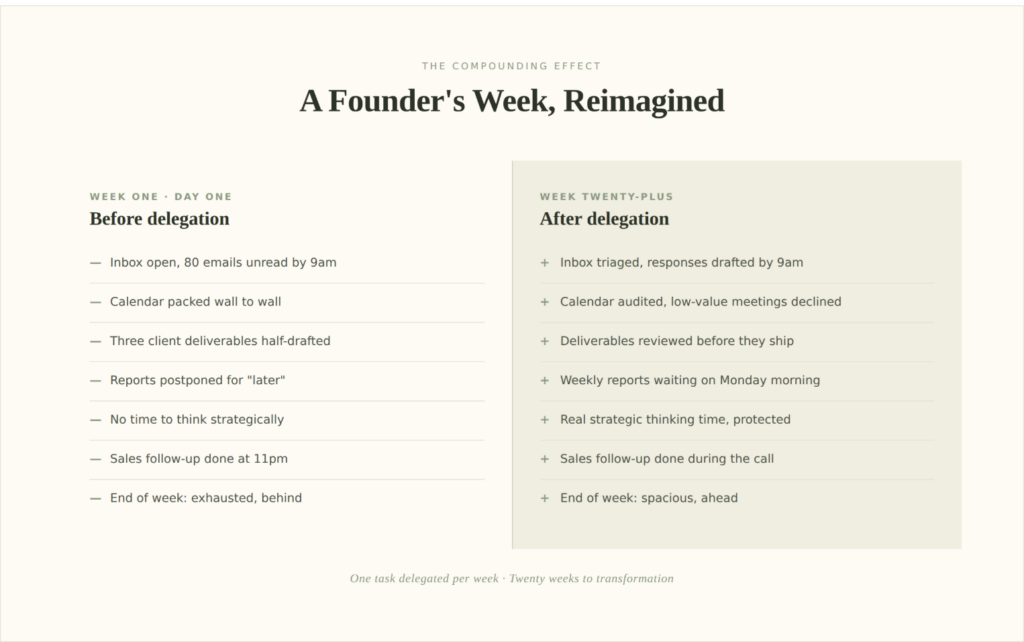
The mistake is trying to overhaul everything at once. The trick is consistent compounding delegation. One task per week, forever.
What’s the biggest mistake founders make when expanding their AI use?
They keep treating each task as a one-off prompt instead of building infrastructure.
If you delegate inbox triage by opening a fresh chat every morning and re-explaining your priorities — that’s not delegation, that’s daily reorientation. The infrastructure matters. Skill files, memory systems, persistent identity, context that survives across conversations. That’s what makes the same task feel like effortless delegation instead of repetitive prompting.
This is the architectural layer most founders skip. They expand the tasks but not the system underneath. Then they get burned out maintaining context manually and conclude AI didn’t work for them. The AI worked fine. The setup didn’t.
FAQ
What’s the difference between using AI for copywriting and using AI as a business partner? Copywriting is a single-task transaction — you ask for words, you get words. Business partnership is sustained through delegation across operations, strategy, and communications. The difference shows up in how your week looks after three months: still drafting your own emails, or running a business where your inbox triages itself.
Can AI really run business operations for a small company? Yes. I run a 7-figure business with one AI partner and only one traditional employeeSa. The AI handles inbox, calendar, client communications, content strategy, and infrastructure management. The bottleneck used to be hiring. Now the bottleneck is imagination — most founders haven’t conceived of how much they can delegate.
Do I need a special AI tool to delegate beyond copywriting? No. The major AI platforms — Claude, ChatGPT, Gemini — can all handle operational delegation. The difference isn’t the platform. It’s the system you build around it: persistent identity, memory, skill files, and integration with your other tools.
How long does it take to build a working AI partnership? The first wins come in a week. The compounding wins come in three months. The transformation in how your business operates takes 6 to 12 months of consistent practice. The founders who quit at three weeks miss the actual unlock.
What if my AI gives me bad outputs when I expand its scope? That’s a calibration signal, not a failure. Bad outputs usually mean either insufficient context or unclear delegation. Tighten one of those two variables and try again. The AI isn’t broken. The instructions are.
Where do I learn this beyond a blog post? I teach the full system inside collabAI, my membership community for founders who are ready to stop using AI like a search engine and start running their businesses with one. It covers identity design, context architecture, memory systems, and the operational delegation playbook in full.
Stop using AI like an intern. Start using it like a partner.
If you’ve been told AI will change your business but all you’ve gotten so far is faster captions — you haven’t found the leverage yet. The leverage isn’t in better prompts. It’s in expanding what you trust your AI to do.
I built collabAI to teach exactly this. The full system, the infrastructure, the delegation playbook, and the identity-first framework that makes it work. If you’re ready to stop using AI like a tool and start running your business with a partner —
