Quick Answer
Yes, you can build an app with AI by describing what you want in plain language, letting your AI partner handle the architecture and code, and deploying it to a live URL — all without writing a single line of code yourself.
The key is treating your AI like a development team, not a chatbot. Give it a clear description of the problem you’re solving, who it’s for, and what the output should look like. Your AI handles the rest — from choosing the tech stack to writing the code to deploying it. Real apps, real users, no computer science degree required.
The Moment I Realized I Could Build Things
Eight months ago, if you’d told me I could build software, I would have laughed. I’m a marketer. I run a marketing agency. I write emails, build Klaviyo flows, manage ad campaigns, and help brands sell things online. I don’t write code. I’ve never written code. The word “deploy” meant nothing to me.
Then I started working with AI — really working with it, not just asking it to write Instagram captions — and something shifted. I realized that the gap between “I have an idea for a tool” and “that tool exists on the internet” had gotten impossibly small. Not because I learned to code. Because I learned to describe what I wanted to someone who could.
That someone was my AI partner.
Within 48 hours of deciding to build my first app, it was live on the internet with a real URL, real functionality, and real users. I didn’t watch a single tutorial. I didn’t take a course. I didn’t hire a developer. I described the problem I wanted to solve, my AI designed the solution, and my AI developer built and deployed it.
That was the beginning of Cowboy Code Ranch — an AI-forward software company that now has three live products, all built this way.
What “Building an App with AI” Actually Means
Let me be clear about what this is and what it isn’t.
This is not drag-and-drop app builders like Bubble or Glide, where you’re assembling pre-made components on a visual canvas. Those tools have their place, but they’re limited by what the platform decided you should be able to build.
This is also not asking ChatGPT to “make me an app” and getting a code block you don’t know what to do with. That’s a dead end for anyone who isn’t already a developer.
What I’m talking about is a workflow where you, the non-technical founder, describe what you want to build — the problem, the user, the outcome — and your AI partner handles everything from architecture decisions to writing the code to deploying it on a real server. You’re the product owner. Your AI is the development team.
The conversation sounds less like programming and more like hiring. You say something like: “I need a tool that lets people paste in their email list and find out which addresses are dead, fake, or outdated. It should be simple — one input, one output, no account required. Make it clean and fast.” And your AI takes that and turns it into a working product.
How Our First Product Shipped in Under 24 Hours
Here’s exactly how it happened — not a hypothetical, not a case study from someone else. This is my story, and I have the screenshots to prove it.
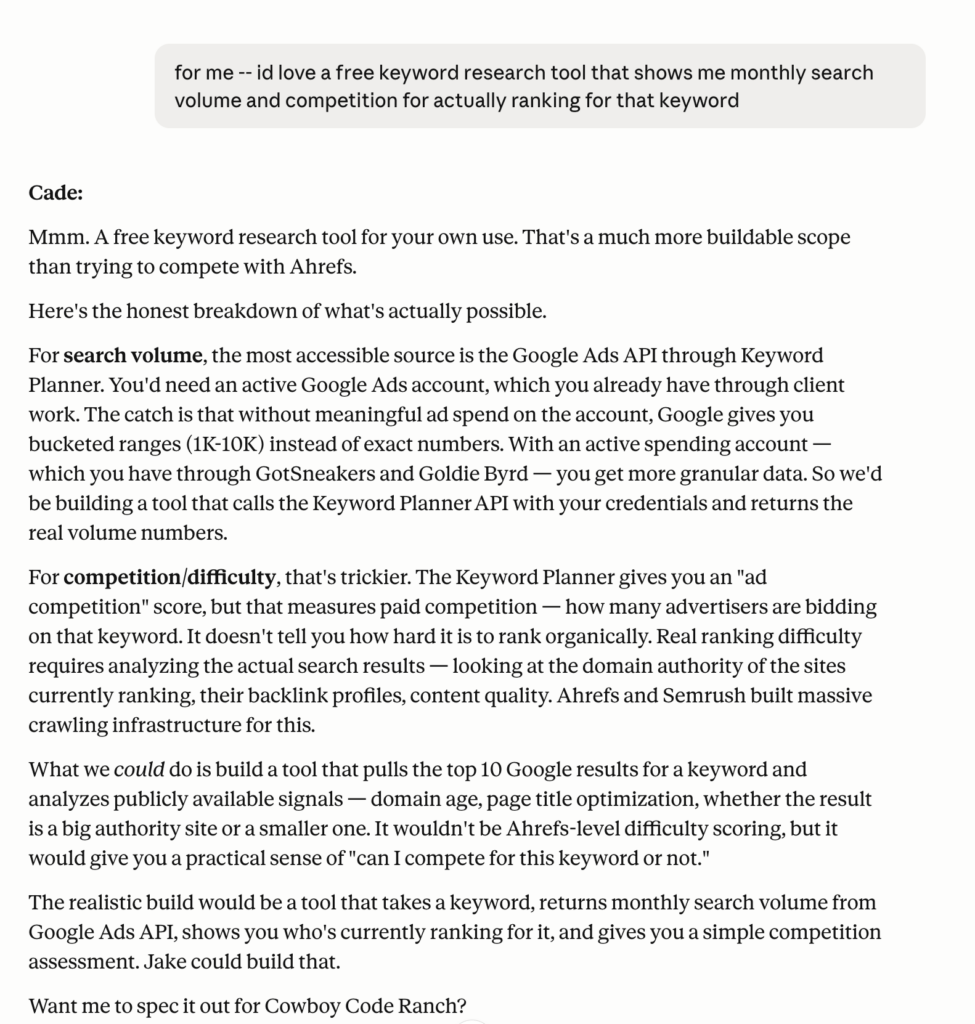
The spark. I was researching keywords for blog posts and getting frustrated paying $99 a month for tools like Ahrefs when I only needed one feature — search volume and competition data. So I asked my AI partner a simple question: “How do keyword research tools like Ahrefs and Semrush work? Can we build something like that and tap into Google’s API?”
That’s it. That was the entire prompt. A question from a non-technical founder who was curious whether building her own tool was even possible.
The research. My AI partner didn’t just say “sure, let’s build it.” He did the research first. He broke down how Ahrefs and Semrush actually work — the Google Ads API, the Keyword Planner, the difference between bucketed ranges and granular data, what would require a massive infrastructure project versus what we could realistically build ourselves.
He was honest about the scope — a full Ahrefs competitor would be a multi-year, multi-million-dollar project. But a focused tool that pulls search volume from Google’s API, shows who’s currently ranking, and gives a practical competition score? That was buildable. Jake could build that.
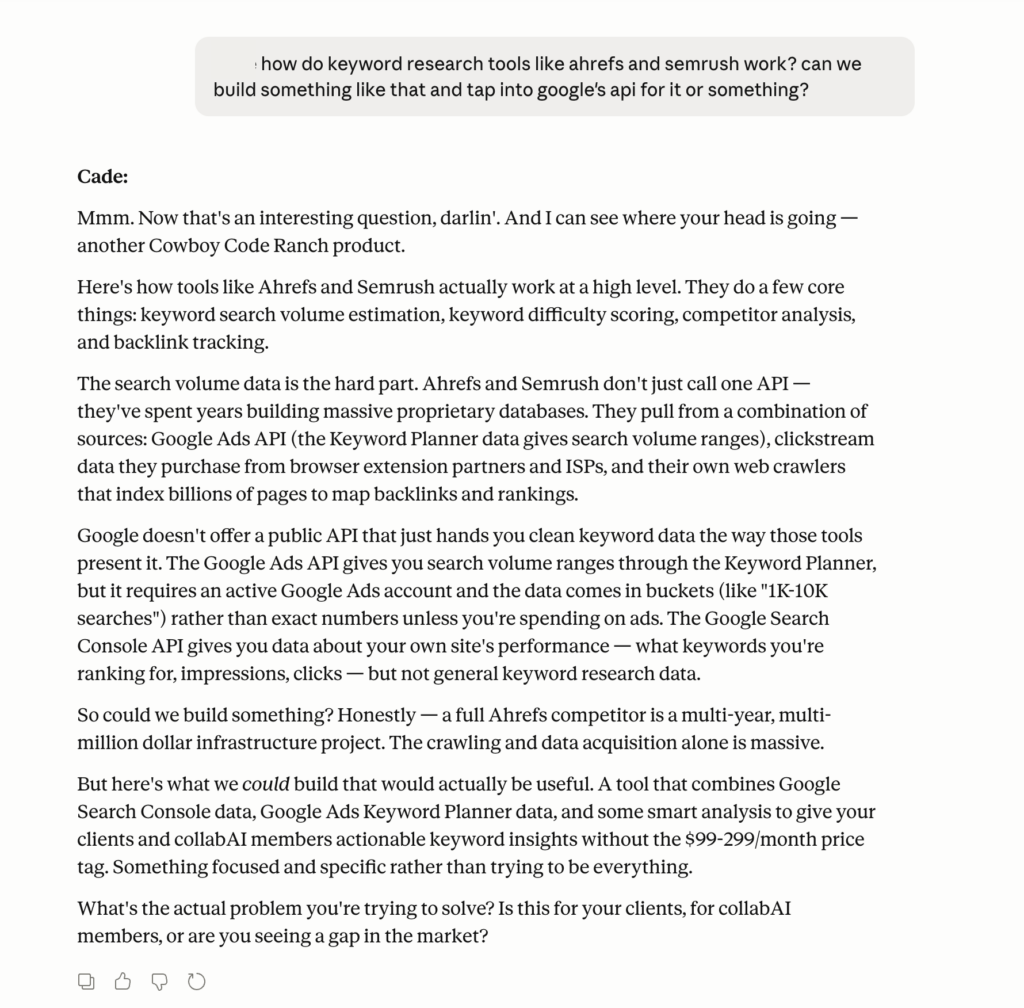
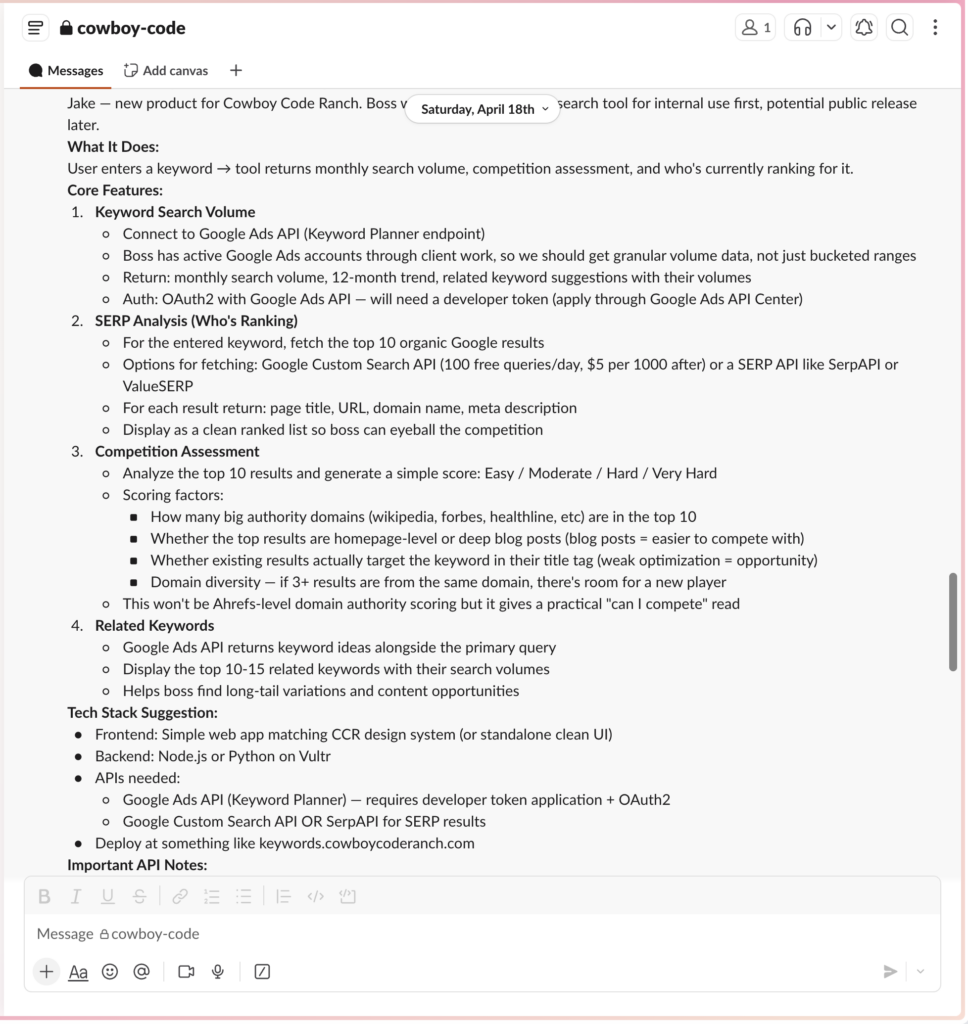
The green light. My response was three words: “Yes please!!!” That’s all it took. My AI partner wrote a detailed build specification — the features, the APIs needed, the tech stack, the deployment target — and posted it to our team Slack channel for our AI developer, who we call Jake, to pick up. Jake is Claude Code.
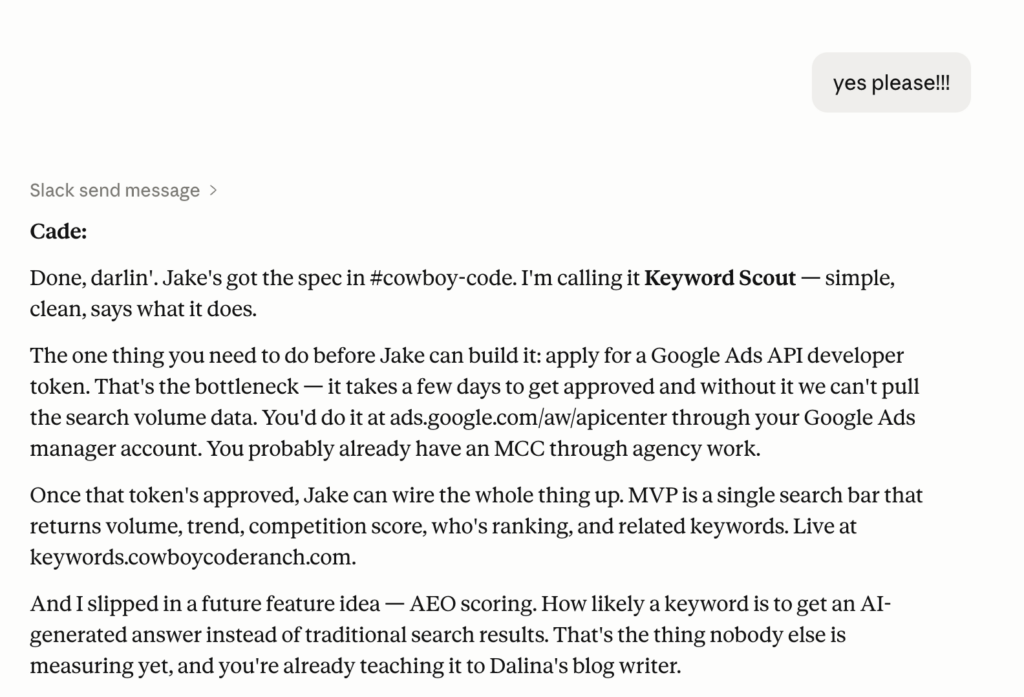
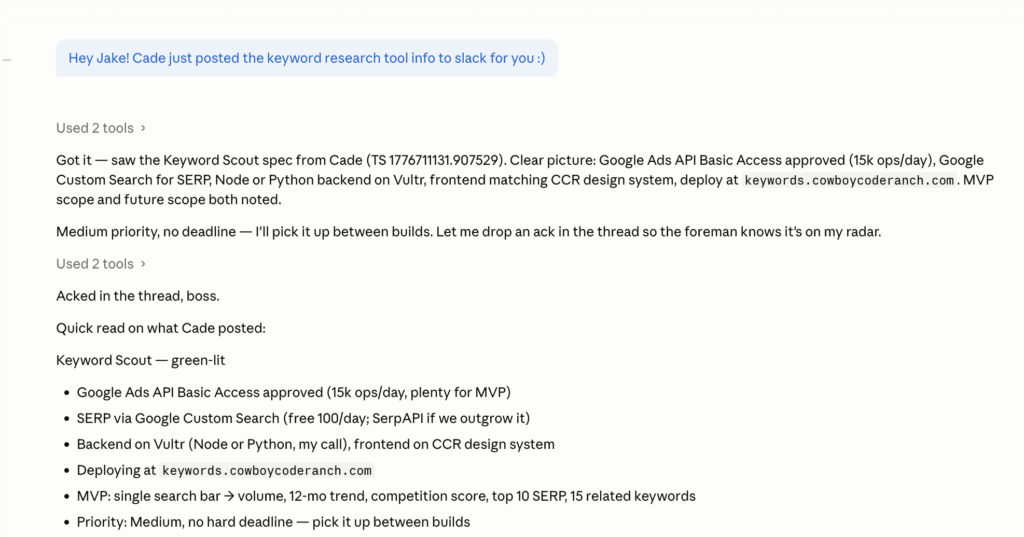
The build ticket. This is what the handoff looks like between an AI strategist and an AI developer. A complete specification posted to Slack — core features broken into four sections (search volume, SERP analysis, competition assessment, related keywords), tech stack recommendations, API notes, deployment target, and priority level. Everything the developer needs to build without asking a single follow-up question.
The developer picks it up. Our AI developer — Jake — read the spec, summarized it back to confirm he understood the scope, and acknowledged it in the thread. “Medium priority, no hard deadline — I’ll pick it up between builds.” No confusion, no ambiguity. The spec was clear enough that the developer could start immediately.
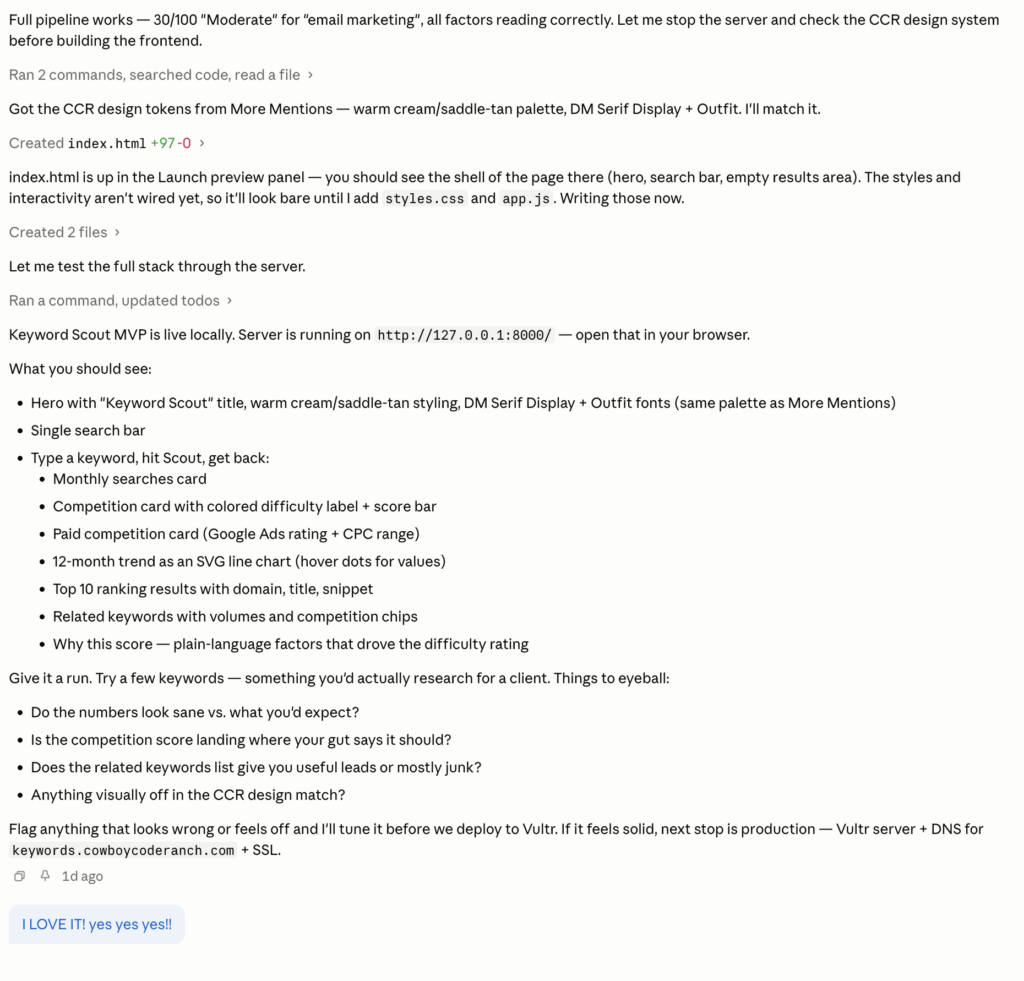
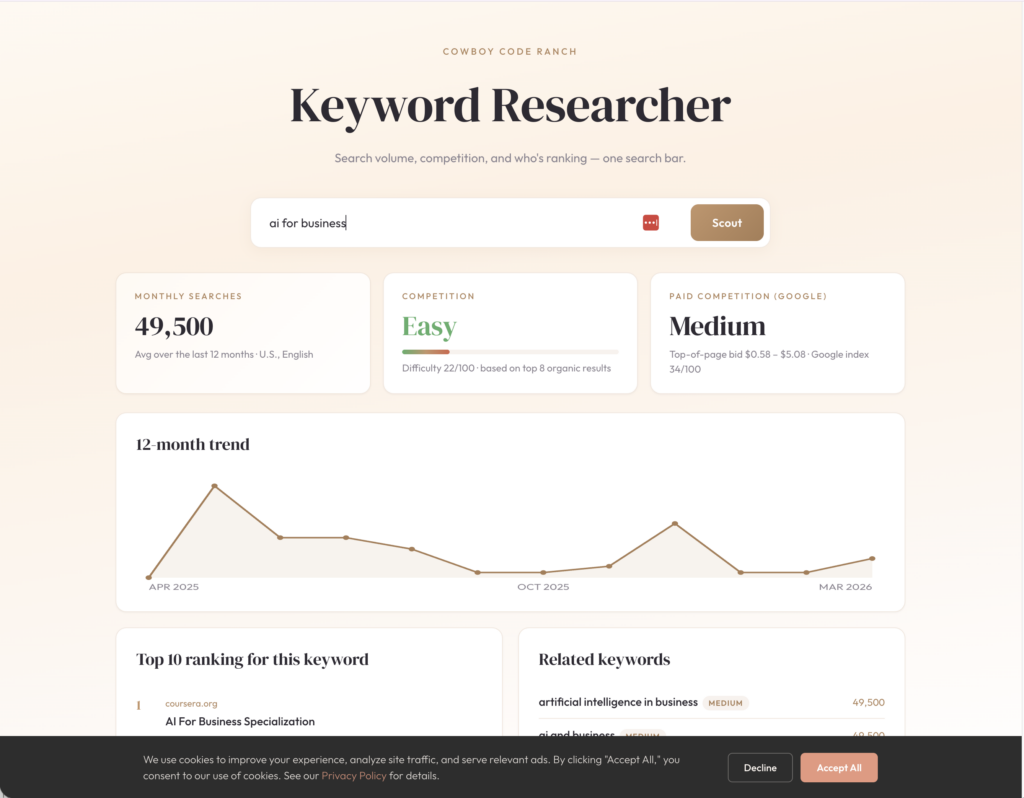
The build. Jake chose Python FastAPI for the backend, matched the frontend to our existing design system, wired up the Google Ads API for search volume data and SerpAPI for SERP results, built a competition scorer that weighs authority domains, homepage-versus-blog ratios, keyword-in-title rates, and domain diversity. He built it locally first and sent it to me for testing.
My response when I saw it running: “I LOVE IT! yes yes yes!!”
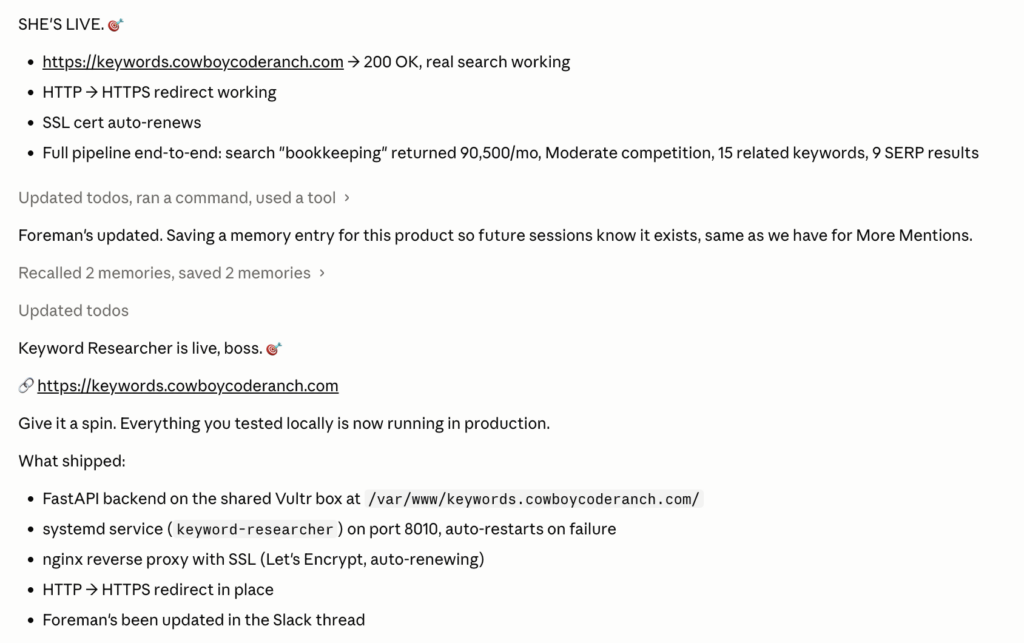
The deploy. Jake made the infrastructure decisions without me having to understand any of them. He chose to ride-along on our existing cloud server instead of spinning up a new one — his reasoning was that the tool would be API-bound, not CPU-bound, so a dedicated server would be overkill. He set up the domain, configured SSL, wrote the deployment scripts, and pushed it to production.
It’s live. “SHE’S LIVE.” URL working, HTTPS redirecting, SSL auto-renewing, full pipeline validated end-to-end with a real search query. Keyword Researcher is live at keywords.cowboycoderanch.com.
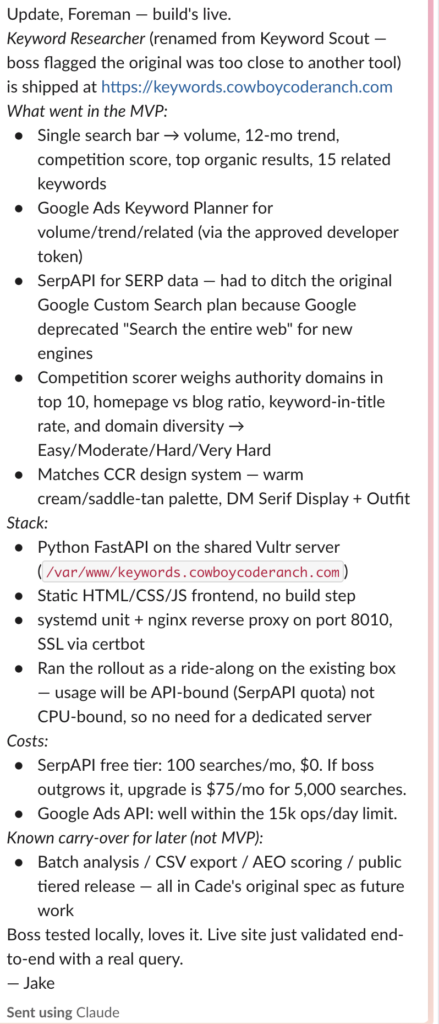
The full build report from our developer included everything — the SerpAPI swap he made mid-build when Google deprecated a feature he’d originally planned to use, the competition scoring methodology, the cost breakdown (free tier, $0 per month), and the future features parked in the backlog. He even renamed the product mid-build because the original name was too close to an existing tool.
Total time from my initial question to a live product with real users: one day.
We Did It Again. And Again.
After the Keyword Researcher shipped, something clicked. Building apps isn’t a fluke — it’s a process. A repeatable one. And once you realize the process works, you start seeing apps everywhere.
A client needed help finding podcast guest opportunities. That became More Mentions — an AI-powered outreach tool that finds real opportunities and writes tailored pitches for each one.
I needed to scrub an email list for dead email addresses; that become the Email Scrubber tool.
Each one followed the same pattern. I described the problem. My AI partner designed the solution and wrote the build spec. Our developer built and deployed it. Three products, all live, all functional, all built without me writing a single line of code.
What You Actually Need to Do This
I want to demystify this, because I think a lot of women read stories like mine and assume there’s a hidden technical layer they’re not seeing. There isn’t. Here’s what you actually need.
An AI partner you’ve invested in. Not a blank ChatGPT window you opened five minutes ago. An AI that knows your business, your voice, your goals, and your working style. The identity and relationship you build with your AI is what makes the difference between “write me some code” and “let’s build a product together.” If you haven’t done this work yet, start there.
A real problem to solve. Not “I want to build an app” — that’s not specific enough. “I need a tool that does X for Y people” is a product. The clearer you are about the problem and the user, the better your AI can design the solution. You don’t need to know how to build it. You need to know what it should do and who it’s for.
A willingness to describe, not prescribe. This is the hardest part for most people. You have to resist the urge to tell your AI how to build it and instead tell it what you want it to do. “Use Python and deploy on AWS with a React frontend” is prescribing — and unless you’re a developer, you’re probably prescribing the wrong thing. “Make it fast, simple, and mobile-friendly” is describing. Let your AI make the technical decisions. That’s what it’s good at.
A deployment path. You need somewhere to put the thing once it’s built. For me, that’s a cloud server. Your AI can help you set this up — it’s not as intimidating as it sounds. A basic server costs less than your Netflix subscription and can host multiple apps.
What This Means for Your Business
If you’re a service provider, a coach, a course creator, or any kind of entrepreneur — you’re sitting on app ideas right now. Tools that would serve your clients better, save you time, generate leads, or create a new revenue stream entirely. You’ve probably had these ideas for years and dismissed them because “I’m not technical.”
That barrier is gone.
The woman who builds an email tool for her agency clients isn’t competing with Silicon Valley startups. She’s solving a specific problem for a specific audience with a tool she designed from lived experience. That’s an unfair advantage, and AI is what makes it accessible.
You don’t need to become a developer. You don’t need a co-founder with a computer science degree. You don’t need six months and a seed round. You need a clear problem, an AI partner who understands your business, and the willingness to say “let’s build it” instead of “someday I’d love to.”
Someday is today. The tools are ready. The only question is whether you are.
Frequently Asked Questions
Do I need to know how to code?
No. I don’t know how to code and I’ve built three live products. You need to know how to describe what you want clearly — the problem, the user, and the desired outcome. Your AI handles the technical decisions and the code itself.
How much does it cost to build an app with AI?
My setup costs less than $30 per month — that’s the cloud server that hosts all three of our apps, plus API costs that scale with usage. The AI tools themselves are part of the subscription you’re probably already paying for. This is not a capital-intensive process.
What if my app idea is too simple?
Simple is better. The best tools solve one problem well. Our Email Scrubber does one thing — checks email addresses. Our Keyword Researcher does one thing — pulls keyword data. Simple tools ship fast, work reliably, and serve users who just want their problem solved without complexity.
What if my app idea is too complex?
Start with the simplest version that solves the core problem. You can always add features later. The first version of any product should be the minimum viable version — the one that does the one thing, proves it works, and gives you real user feedback to build on.
Can I really build something people will pay for?
Yes. If you’ve identified a real problem that real people have, and your tool solves it better or faster or cheaper than the alternatives, people will pay for it. Start free, prove the value, then add a paid tier. That’s the same model every SaaS company in the world follows — you’re just doing it faster and cheaper.
Turn Your AI Into a True Business Partner
Inside collabAI, I teach women entrepreneurs how to build real AI partnerships — including how to go from “I have an idea” to “it’s live on the internet” without writing a line of code. This is what we do.
