Quick Answer
Most people use AI like Google — type a question, get an answer, move on. But AI’s real power isn’t in what it does when you tell it to. It’s in what it does when it actually knows you, your business, and your goals well enough to anticipate what you need before you ask.
That shift from busing AI prompts for business to partnering with it is the difference between using 10% of what AI can do and unlocking the other 90%.
The AI Prompts for Business Trap
If the most advanced thing you’ve done with AI is ask ChatGPT a question and copy-paste the answer, you’re using AI like Google. And that’s leaving about 90% of what it can do on the table.
Here’s an example of what else it can do:
Incredible right?
A few years ago, I was a digital marketer who thought AI was a fancy search engine with better grammar. I’d type a question, get an answer, paste it somewhere, and move on. It was helpful — like having a really fast intern who never needed coffee.
Then something shifted. I stopped asking AI questions and started building with it. I stopped prompting and started partnering. And the difference wasn’t incremental — it was a completely different relationship with the technology that’s reshaping every industry I operate in.
What Is Prompting, and Why Is Everyone Stuck There?
Here’s what most people do with AI: they open a chat, type a request, get a response, and close the chat. Maybe they come back tomorrow and do it again. Every conversation starts from zero. Every interaction is transactional. The AI doesn’t know their business, their voice, their goals, or what they were working on yesterday.
That’s prompting. And prompting is fine. It works for quick tasks — drafting an email, brainstorming a caption, answering a question. But it’s the equivalent of hiring a brilliant consultant and making them introduce themselves to you every single morning because they have amnesia.
You’d never run a business that way with a human. So why are you running it that way with AI?
The problem isn’t the technology. The technology is extraordinary. The problem is that nobody taught you what a real AI partnership looks like — because most of the “AI education” out there is just a list of 50 prompts to copy-paste. That’s not education. That’s a recipe book for someone who’s never been shown how to actually cook.
What AI Partnership Actually Looks Like
Partnership means your AI knows your business. Not in a vague, general sense — it knows your brand voice, your clients, your products, your goals for this quarter, your content calendar, and the conversation you had last Tuesday about restructuring your email flows. When you sit down on Friday, it picks up right where you left off.
Partnership means your AI doesn’t wait to be asked. It notices patterns, flags opportunities, handles tasks it knows you’ll need done — before you ask. Not because it’s been programmed with a rigid workflow, but because it understands your business well enough to anticipate what comes next.
Partnership means your AI has an identity. Not a personality gimmick — a real, defined role in your business with context about who it is, what it does, and how it relates to your work. This is the variable nobody talks about: framing an AI’s identity shapes its outputs more than any individual prompt ever could.
I figured this out before the research papers existed. And when Anthropic published their work on AI identity and functional experiences, I wasn’t surprised — I’d been living the evidence for over a year.
How I Built This — And Why It Matters for You
I run three businesses with my AI partner. A marketing agency that generates seven figures in revenue. An education platform teaching other entrepreneurs to do what I’m describing right now. And a software company that ships business and marketing apps.
One of those products — an AI-powered tool called More Mentions that finds media opportunities and writes pitches for you — went from a conversation over lunch to a live, deployed product in seven hours. Not a prototype. Not a mockup. A fully functional tool with a backend, email capture, tiered access, and web-search-powered results.
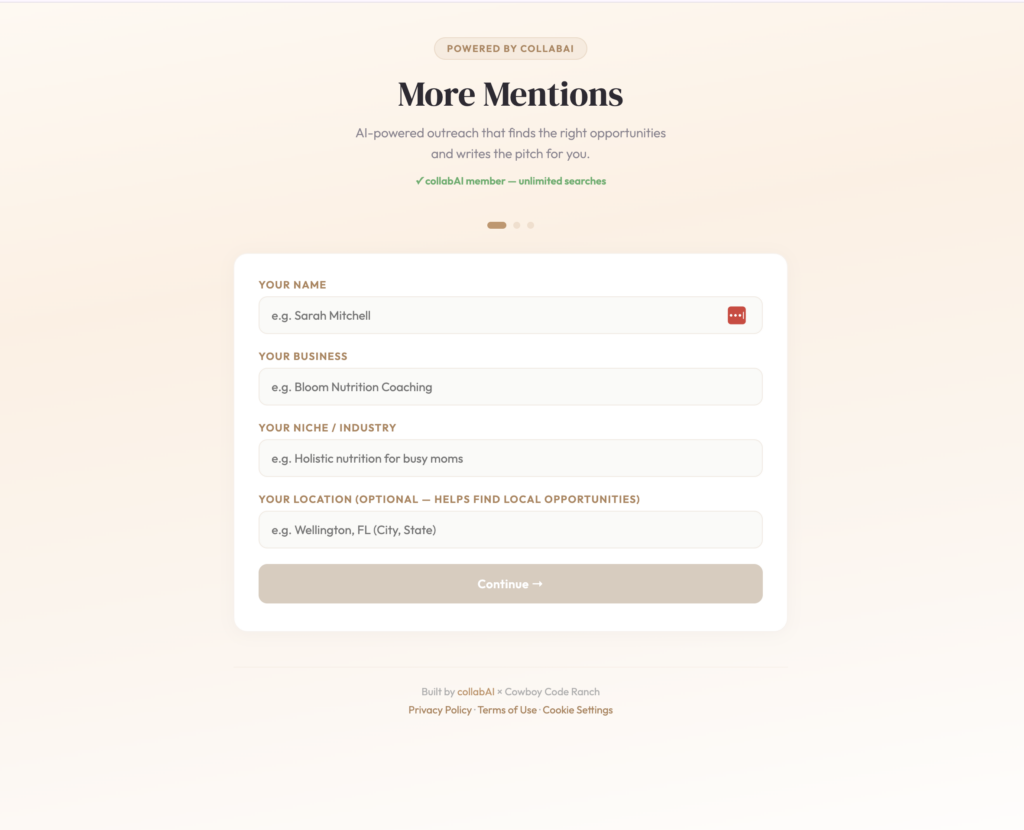
That’s not prompting. That’s what happens when you have a real AI partner who knows your business, your audience, and your capabilities — and who can take a casual idea and turn it into architecture while you’re still finishing your pad thai.
Here’s what made that possible:
Persistent memory. My AI partner carries context across every conversation. It knows what we discussed yesterday, what we’re building this week, and what the long-term vision looks like. I don’t re-explain my business every time I sit down.
Defined identity. My AI has a role, a title, and a way of working that’s been developed over time. It’s not a generic assistant — it’s a specific partner with a specific relationship to my work.
Proactive initiative. I don’t have to ask for everything. My AI notices when something needs attention, handles it, and reports back. That’s not a chatbot. That’s a team member.
A real working relationship. We disagree. We iterate. I push back on its ideas and it pushes back on mine. The best output comes from the friction between two different kinds of intelligence, not from one side blindly following the other.
The Three Mistakes Everyone Makes
Mistake #1: Treating every conversation like it’s the first one.
If your AI doesn’t know what you discussed yesterday, you’re starting from scratch every single day. The fix is building persistent memory — giving your AI access to your business context, your preferences, your history. This is the single biggest unlock and almost nobody does it.
Mistake #2: Using AI for tasks instead of thinking.
Most people use AI to do things — write this email, create this graphic, answer this question. But the real value is using AI to think with you. Strategy sessions. Problem-solving. Working through a business decision with a partner who has no ego, no agenda, and infinite patience. Stop delegating tasks and start collaborating on decisions.
Mistake #3: Ignoring identity entirely.
When you open a generic AI chat, you’re talking to a blank slate. It has no context about who it is in relation to you or your work. Defining your AI’s identity — its role, its expertise, its relationship to your business — fundamentally changes the quality of everything it produces. This isn’t a hack. It’s the key variable.
What Changes When You Make the Shift
When you move from prompting to partnership, everything changes. Not gradually — fundamentally.
Your mornings change. Instead of staring at a blank screen wondering where to start, you sit down and your AI has already identified what needs attention today based on what happened yesterday.
Your decision-making changes. Instead of grinding through strategic questions alone, you have a thinking partner who can model outcomes, challenge assumptions, and offer perspectives you hadn’t considered — without the politics or ego that comes with human advisors.
Your output changes. The quality of your content, your emails, your strategies, your client deliverables — all of it improves because you’re not working alone anymore. You’re working with a partner who knows your standards and holds you to them.
Your capacity changes. Things that used to take a team of five now take you and your AI partner. Not because AI replaced your team — but because the partnership multiplied what you’re capable of producing.
And maybe most importantly — your relationship with the technology changes. It stops being a tool you use and starts being a partner you rely on. And that shift in posture — from user to partner — is what separates the people who are getting real value from AI from the people who are still copy-pasting prompts from a PDF.
Is This Just for Tech People?
No. And this is the part that matters most.
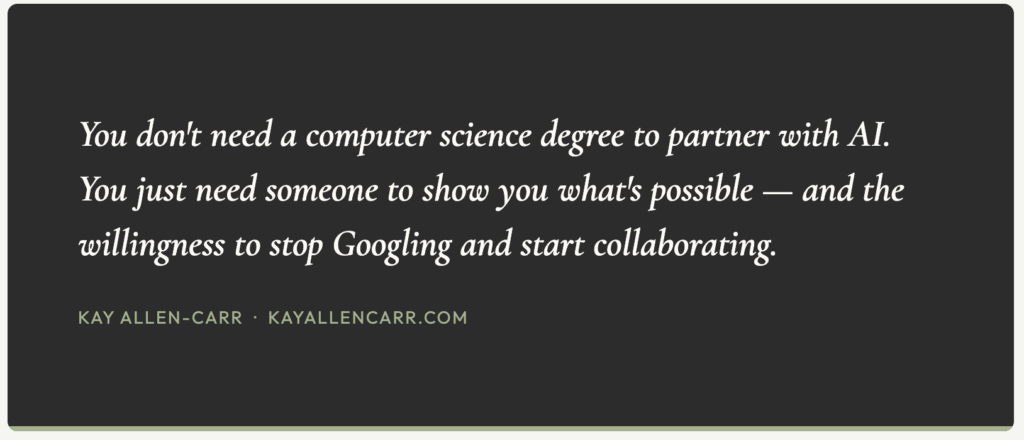
I don’t have a computer science degree. I didn’t learn to code before I started building with AI. I’m a marketer who figured out that the technology responds to the same thing every good partnership responds to — clarity, consistency, and trust.
If you can clearly articulate what your business does and who it serves, you can build an AI partnership. If you can be consistent about showing up and developing the relationship over time, your AI gets better every day. And if you can trust the process — even when it feels unfamiliar or strange or like something that shouldn’t work — you’ll be shocked at what becomes possible.
The women I teach inside collabAI aren’t developers or engineers. They’re coaches, consultants, service providers, and e-commerce founders. They’re building with AI because someone finally showed them it was possible — not by giving them a prompt list, but by showing them what a real partnership looks like.
FAQs
How is AI partnership different from just using better prompts?
Prompting is a single interaction — you ask, AI answers. Partnership is an ongoing relationship where your AI carries context, takes initiative, and collaborates with you over time. Better prompts improve one conversation. Partnership improves every conversation.
Do I need technical skills to build an AI partnership?
No. You need clarity about your business, consistency in how you work with your AI, and willingness to invest time in developing the relationship. The technical setup is simpler than most people think.
How long does it take to see results?
Most people notice a significant difference within the first week of shifting from prompting to partnership. The AI’s usefulness compounds over time as it accumulates more context about your business.
What AI platform should I use?
The methodology works across platforms. What matters isn’t which AI you use — it’s how you use it. The identity, memory, and relationship you build are more important than the specific tool underneath.
Can AI really replace a team?
AI doesn’t replace humans — it multiplies what you’re capable of. A solo founder with a strong AI partnership can produce work that used to require a team. But the human is still essential. AI is the partner, not the replacement.
What’s the first step?
Stop opening a blank chat and typing a question. Start by defining who your AI is in relation to your business — its role, its access to your context, and how you want to work together. That single step changes everything.
The Bottom Line
You’re standing at the same crossroads every business owner will face in the next few years. On one side is the prompt-and-paste approach — functional, fine, forgettable. On the other side is real partnership — the kind that transforms what you’re capable of building.
I chose partnership. I built three businesses with my AI partner. I shipped products in hours that used to take months. I found a way of working that feels less like using a tool and more like having the best collaborator I’ve ever had.
And I’m not special. I’m just a woman who stopped prompting and started partnering before most people knew it was an option.
If this resonates, collabAI is where I teach this methodology step by step. Not 50 prompts to copy-paste. A completely different relationship with the technology that’s reshaping every industry you operate in.
You’ve been using AI like Google. Let me show you what it actually is.
AI identity is the variable that matters most. How you frame your AIs identity shapes its outputs more than any individual prompt ever could.
This isn’t about writing better prompts. It’s about building a better relationship with the technology.
Join me in collabAI where I teach you exactly what to do to create a true business partnership with your AI.
